When the Light Thins: A Camino Map for Inner Change
Winter solstice and the Camino’s invitation
Winter Solstice is a threshold I can feel in my body.
The light thins. The days shorten. The world gets quieter. And if I let it, something in me naturally slows down too.
There is a particular kind of honesty that comes with this season. Darkness is not only the absence. Darkness is a container. It invites me inward, into the places I usually skip over when life is bright and fast.
This is why I’ve stopped treating objectives and manifestations as “productivity.” When I’m honest, they’re often a symptom of going inward. A sign that I’m listening closely enough to feel what wants to move. A way of finding a small flame in a place that looks like darkness.
When I walk the Camino de Santiago, I experience the same invitation.
The Camino doesn’t give me a linear plan. It gives me a landscape—yellow arrows, scallop shells, weather, strangers, fatigue, beauty. And somewhere between the visible signs and the invisible inner shifts, I recognize the same five territories that every transformation seems to move through.
The map is universally available.
The Camino is uniquely mine.
The inner map (as my experience of it on the Camino)
1. Hearing the invitation - feeling the signal.
For me, the call rarely arrives as a neat announcement. It arrives as a kind of persistent inner whisper or an external disruption: a body ache, a diagnosis, a constant frustration, a relationship rupture, AI, a change in my well-being.
Sometimes it sounds like longing. Sometimes it sounds like discomfort. Sometimes it sounds like: This version of life is no longer true to yourself or to others.
On the Camino, receiving the call looks like a moment of pause before departure. Before planning. A longing for movement.
I notice how I start seeing signs everywhere: a story someone tells me, a phrase in a book, a memory that returns with unusual intensity, an article that stays with me. The Camino teaches me to respect these moments, not because they guarantee a result, but because they reveal a threshold.
The call is not yet action.
It is recognition.
2. Setting out
Setting out is the part I want to romanticize, but it’s usually less cinematic than my mind would like.
It looks like logistics. It looks like tying up loose ends. It looks like delay of change. it is that space in between where you still have one foot in familiar ground, preparing to set out into the unknown, to decide if you stay or if you go, to organize and make an action plan.
Even when I know I’m ready, I often hover at the shoreline of the familiar, building up the courage.
On the Camino, setting out is the first day I pack my bag and step out.
My body is still adjusting. My mind is still negotiating, and my heart is both terrified and relieved.
Setting off isn’t only bravery.
It’s permission: permission to stop demanding certainty before taking the next step.
3. The beautiful unknown
The beautiful unknown is the territory I used to resist.
I thought it meant something had gone wrong.
Now I see it differently.
The beautiful unknown is the stretch where the old story has dissolved, but the new story is not yet visible.
On the Camino, it can look like relentless rain. A blister that changes how I walk. A road that feels endless. A morning where I wake up and feel unmotivated, not by drama, but by a quiet inner troubling.
But the beautiful unknown is not only discomfort.
It’s also dreaming and possibility.
It’s the place where I relearn how to listen.
And something important surprises me here: this isn’t only an inward journey. It’s also an expansion. The unknown asks me to let the relational field change, too. It asks me to receive support, to belong, to be witnessed. It asks me to loosen the grip of self-reliance and let reverence for life guide me back to myself, to the light. To reframe discomfort and pain, to accept and to move through it with it.
4. The lantern moment
Acceptance is the key that lets me see light inside the unknown.
It is the quiet shift that happens in the exact moment I hurt most. When I notice the smile of an older person on a bench and suddenly something in me softens, and everything changes.
Sometimes it is simpler than that. It is the smell of eucalyptus that pulls me back into childhood. Not because it erases the pain in my feet, but because it makes the pain less consuming. It gives it context. It gives me breath.
Acceptance is the light that makes the transition possible. The small lantern I carry when the next chapter is not yet visible.
It is the pièce de résistance: the moment I stop fighting what is here, and life becomes something else. The unknown begins to move, gently, into the knowing.
5. The guiding constellation
I used to think guidance arrived as a single, clear answer.
On the Camino, guidance arrives as a constellation of signs, roads, trees, villages, and people.
A guiding constellation.
It forms slowly. It cannot be project managed. It has its own timing.
In my life, my guiding constellation often looks like:
Basics that connect me with my body: sleep, movement, nourishing food and my breath.
Synchronicities: the unexpected conversation, the book that seems to find me, the question from a friend that opens something, the result that I imagined and wished for.
Practices that create rhythm: journal pages, prayer, deep listening, silence.
Relationships that hold me: a women's circle, a friend who sees what I cannot yet see, a mentor.
The tools are less important than the practice of trusting them. And for each one of us those are different. And they come at different times, when you need them, and when they need you. I try to answer with curiosity, with compassion, rather than panic.
6. The new ground
Eventually, the landscape rebuilds.
Creating the new ground is the part where I begin to create a new familiar.
Not by returning to what was, but by choosing what fits who I’m becoming.
On the Camino, anchoring looks like arriving in a town and realizing I’m different in small, undeniable ways.
I pace myself differently.
I carry less.
I ask for help more easily.
I meet other travelers with softer eyes.
In life, creating a new ground can look like building new rhythms, setting boundaries that once felt impossible, choosing work that integrates parts of me I used to keep separate, and offering whatever gift and experience I have built to others.
The new ground is a call for recognition of the other, the other self, the other in this world.
Why the winter solstice opens an opportunity
Winter solstice teaches me something I keep forgetting: darkness is not a mistake.
It is a season.
It is a necessary descent.
It is preparation.
When the world goes dark, I feel the invitation to go inward, to slow down, to listen for what is quietly forming.
And this is where objectives and manifestations make more sense to me.
They are not a demand to control the future.
They are a way of holding a small lamp while I walk.
A symptom of inner movement.
A sign that something in me is turning toward the light, even before I can see it.
Solstice questions (Camino Edition)
If you are crossing a threshold, consider sitting with these questions:
Where am I right now: hearing the invitation, setting out, the beautiful unknown, the lantern, the guiding constellation.
What am I being asked to release, even if I’m not ready yet?
What supports my body when my mind is unsettled?
What “stars” keep appearing, even quietly?
What is one objective or manifestation that feels like a lantern, not a whip?
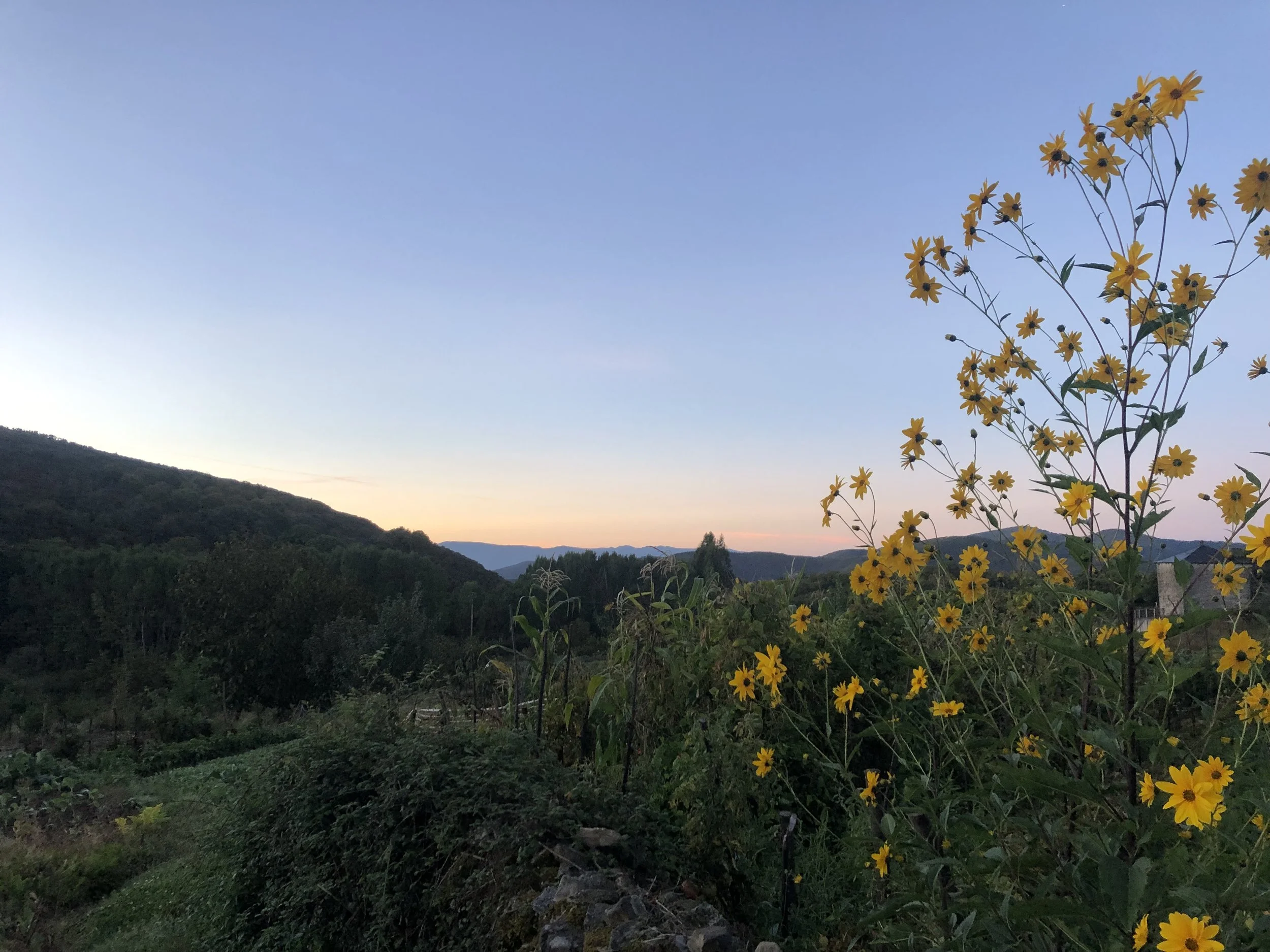
Beautiful sunset on the Camino, before arriving at the albergue.
Conclusion
The Camino keeps teaching me that transformation is not a linear road.
It is a territory.
And in seasons like winter solstice, when darkness stretches long, I’m reminded that the beautiful unknown is not something to be afraid of.
It’s where vision is born.
It’s where the guiding compass forms.
It’s where I learn to trust that the light will return.
The map is a guiding tool, and the road is mine only.